

2026 LEGISLATIVE SESSION RECAP
The 2026 legislative session brought more lawmakers, advocates, and community members to the discussion about better animal protections in Connecticut. From companion animals and wildlife, to accountability and humane treatment, animal welfare remained a visible and important part of the legislative agenda.
Every piece of testimony, every vote, and every person that spoke up helped build momentum toward a future where all animals are treated with greater compassion, dignity, and respect.
Prior to the start of the legislative session, CVA identified five priority issues.
Continue on to see how these issues progressed and discover the key wins for animals this session.

This year's scorecard brings everything you need to navigate the legislative process together in one place.


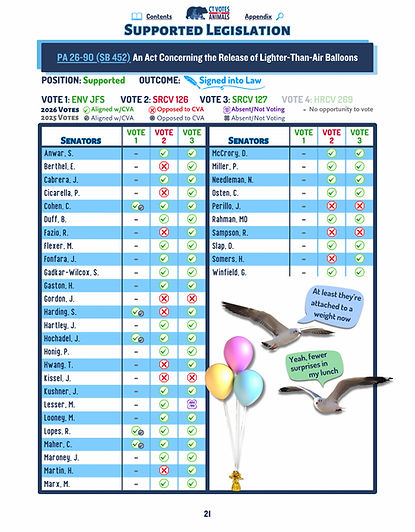

it's never been easier to track where your legislators stood on the bills that are shaping animal protections across Connecticut!
Download the scorecard and explore the full story from this year’s legislative session!

Animal Welfare Protections
Animal welfare protections affect both the animals and the people who care for them. In Connecticut, many domestic violence survivors face the impossible choice between their own safety and the safety of their pet, as abusers frequently use pets as tools of manipulation and control (National Link Coalition). At the same time, programs like the Animal Population Control Program (APCP) are critical in supporting responsible pet stewardship and addressing overpopulation concerns.
Strengthening these protections and programs help create safer communities for animals, support families in times of crisis, and ensure that these resources remain effective and accessible.
How We're Working to Strengthen Animal Protections
This bill began addressing barriers faced by domestic violence survivors with companion animals, improving Connecticut's Animal Population Control Program (APCP), and enhancing the state's ability to respond to animal disease outbreaks.
Explore the Issue
2026 Outcome
SB 318 was signed into law with most provisions going into effect on October 1, 2026. This marks a major step forward in Connecticut's quest to improve and expand animal welfare protections.
Animal Cruelty

Connecticut is facing a dual crisis:
Increasing Animal Cruelty Crimes
&
Decreasing Legal Accountability
-
2023-24: 36.6% increase in animal cruelty crimes. (DESPP, 2025)
-
2024-25: 17.7% estimated increase in animal cruelty crimes. (Desmond's Army, 2025)
-
2024: 94% of disposed cases resulted in little to no meaningful consequence. (Desmond's Army, 2025)
-
2025: 80% of disposed cases resulted in little to no meaningful consequence. (Desmond's Army, 2025)
How We're Working to Address Animal Cruelty
This bill would have limited accelerated rehabilitation (AR) use in animal cruelty cases, helping ensure that offenders face meaningful consequences for harming animals.
This bill would have expanded Desmond's Law, allowing court-appointed advocates to represent more animals than just cats and dogs in animal cruelty cases.
Explore the Issue
2026 Outcome
While neither bill became law in 2026, both helped elevate animal cruelty as a legislative priority and build support for stronger protections. CVA will continue working with lawmakers and advocates to advance these reforms in upcoming legislative sessions.

Ban Poisons
There is no such thing as a safe poison. Second-generation anticoagulant rodenticides (SGAR's) and neonicotinoids (neonics) are commonly used poisons that are extremely dangerous to pets, children, and wildlife. In 2025, Connecticut passed a weak law that will continue to allow the use of both of these poisons.
-
SGAR's were reclassified to "restricted use," allowing the hundreds of applicators across the state to continue using them.
-
Neonics were explicitly permitted to be used on shrubs and bushes; areas that are vital to insects.
There was unfortunately no bill that would ban these poisons in 2026. However, one bill would help with tracking data:
How We're Working to Ban Poisons
This bill established a working group to examine ways to modernize the state's existing pesticide database.
Explore the Issue
2026 Outcome
This bill was signed into law, taking effect upon passage and requiring the working group to submit their recommendations by January 15, 2027.
Balloon Release Ban

Every balloon released inevitably returns to the ground, causing entirely avoidable damage. Prohibiting the release of lighter-than-air balloons would prevent further harm to wildlife through ingestion and entanglement while also decreasing the amount of litter and habitat contamination balloons cause.
How We're Working to End Releasing Balloons into the Environment
This bill prohibited the intentional release of any lighter-than-air balloons and required retailers to attach weights to these balloons prior to sale.
SB 452 – Balloon Release Ban
Explore the Issue
2026 Outcome
This bill was finally signed into law after years of work, marking a major victory for advocates across the state.
Pet Store Animal Sales Ban

The puppy mill to pet store pipeline is a well-documented issue that perpetuates the mistreatment of dogs, cats, rabbits, and other thinking, feeling, and loving animals. Connecticut had the chance to ban the sale of animals in pet stores last year but failed to do so.
This failure is felt strongest in Stamford when last year, legislation to ban animal sales was passed but ultimately vetoed by the mayor due to confusion as to whether they had the authority to do so. Uncertainty about municipal authority should not be what stops commonsense reforms.
While a bill to ban pet store animals sales wasn't raised this year, a bill to clear up confusion around local control was:
How We're Working to Ban Pet Store Animal Sales Bans
This bill sought to authorize municipalities to regulate the sale of dogs, cats, and rabbits within their jurisdiction.
Explore the Issue
2026 Outcome
Significant discussion around the multiple amendments proposed for this bill led to it not advancing before the end of session.
Wildlife Killing Permits

For more than a decade, efforts have been made to legalize bear hunting or weaken protections for Connecticut's wildlife. While proponents argue that these measures would reduce human-bear conflicts, research suggests they may actually increase them.
In 2026, the focus shifted to weakening restrictions on wildlife killing permits. The proposed changes would have allowed any wildlife seen near someone's property to be killed, even if they had not caused any damage. Because Connecticut already has laws in place that permit lethal action when wildlife poses an immediate threat to people, pets, or property, this bill raised serious concerns about the erosion of safeguards that help ensure lethal control is only used when truly necessary.
How We're Working to Oppose Wildlife Killing Permit Deregulation
This bill sought to rollback wildlife killing regulations by including damage to crops that occurred during the previous growing season as justification for the Department of Energy and Environmental Protection (DEEP) to issue such wildlife killing permits.
Explore the Issue
2026 Outcome
With very little support, SB 146 died on the Senate calendar, marking a major win in the fight to protect wildlife in Connecticut.
Legislation Tracker
Discover all the bills that CVA was tracking throughout the 2026 legislative session
Session Ended Wednesday, May 6, 2026
Last Updated: Friday, June 5, 2026
Priority Level | Bill No. | Bill Title | Impact | OUTCOME | Position |
|---|---|---|---|---|---|
1 | HB 5283 | AA Authorizing Municipalities To Prohibit The Sale Of Dogs, Cats And Rabbits In Pet Shops | Grants municipalities the authority to regulate the sale of dogs, cats, and rabbits in pet shops. | Died on House Calendar. | Support |
Priority Levels:
1 = Strongly Support
2 = Support
3 = Neutral
4 = Opposed
5 = Strongly Opposed
How CT Votes for Animals Determines its Legislative Priorities
Each legislative session, CVA undertakes the challenging task of determining which issues affecting animals will become the organization’s legislative priorities. While there are countless issues, we must narrow our focus to remain politically effective.
The Decision-Making Process
Many people ask how we decide which issues to prioritize. To make these decisions, we carefully consider a number of variables:
History and Momentum
Is this an issue we have been working on for years? Creating new legislation often requires persistence over multiple sessions. Each year, we may achieve incremental “wins,” but achieving full legislative change can take time. For example, in 2025, second generation anticoagulant rodenticides (SGARs) were changed from ‘general use’ to ‘restricted use’ products. This slight change is a step in the right direction toward an outright ban. In order to achieve this goal, continued advocacy is essential.
Political Climate
What is the current environment at the state level? The budget, for instance, creates challenges for bills that require funding. In a time of fiscal constraints, any bill with a fiscal note has a much harder time moving forward. Shifts in the political landscape greatly influence our ability to advance our priorities.
Legislator Support
Which issues have backing from lawmakers? Each session, we engage with legislators who champion animal welfare and others who may have opposing views. Since all bills rely on legislative sponsors to progress (or risk being stalled), these conversations play a crucial role in shaping our agenda.
Member Expectations
What do our members expect from us? Beyond political feasibility, we aim to address issues that resonate broadly with our supporters. Their passion and advocacy are the backbone of our work.
Remaining Flexible
While we focus on long-term priorities, we also recognize the need to remain agile. Each legislative session brings unexpected bills that could significantly impact animal welfare. This year, as we continue to advocate for our established priorities, we are equally committed to responding swiftly to emerging threats and opportunities.Advocacy is a marathon, not a sprint, and our success depends on strategic focus and unwavering commitment. By balancing persistence, political pragmatism, and responsiveness, CT Votes for Animals ensures we’re fighting for the most impactful changes in animal welfare. We invite you to stay informed and engaged—together, we can make Connecticut a better place for all animals.
Every voice creates a lasting impact.
Thank you for helping create a future where all animals live in peace under the protection of strong laws.
JOIN CVA TODAY!
Don't miss out on your chance to make an impact in 2026! Sign up for CVA's action alerts and be one of the first to know about upcoming committee meetings, public hearings, and more.
Use your voice – SPEAK UP FOR ANIMALS!